From Teach-Ins to Teach-Outs
The University of Michigan held the first Teach-In in 1965, and its impact is still being felt today. The Teach-Out model leverages modern technology to bring the same impactful lessons to the world.
The University of Michigan’s Teach-Out™ model traces directly to the first Teach-In, held in Ann Arbor in March 1965. Both were designed in moments when public events were moving quickly, and many people were searching for context. The format has changed from an overnight gathering in the university’s Angell Hall to global, online learning experiences, but the mission remains consistent: when complex issues demand attention, the university can convene open, informed conversations that extend beyond its own campus.
The First Teach-In
The original Teach-In grew out of faculty opposition to President Lyndon B. Johnson’s escalation of the Vietnam War. In early March 1965, a group of professors announced plans for a one-day “work moratorium” to protest U.S. policy. The response was swift and critical. University leadership publicly rejected the strike, and state legislators and the governor called for disciplinary action. Newspapers framed the effort as irresponsible.
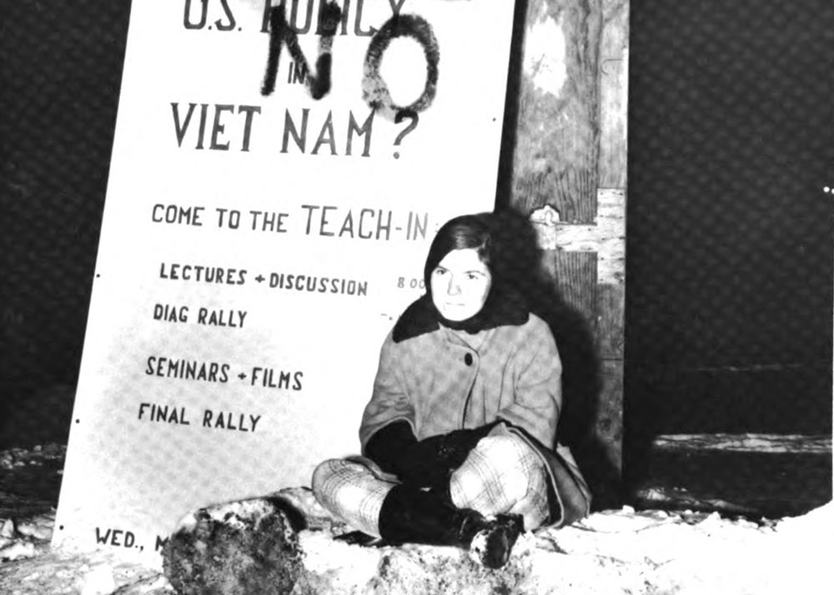
Facing mounting pressure and uneven faculty support, the organizers reconsidered their approach. In a late-night meeting just days before the planned strike, they agreed to replace the moratorium with an all-night educational event. Rather than cancel classes, they would teach more—outside conventional hours and in a format open to broad participation.
The First Teach-In
The Heritage Project at the University of Michigan dives deep into the days leading up to the Teach-In, the organization of the event, and its impact.
From 8 p.m. on March 24 to 8 a.m. on March 25, 1965, more than 3,000 students, faculty, and community members filled Angell Hall. Speakers presented historical and political analysis of the war that differed sharply from official government accounts. Students questioned professors directly. Discussions continued into the early morning, alongside seminars and films organized by both faculty and students. Even bomb threats and counter-protests did not deter the turnout.
By morning, it was clear that something larger than a single event had taken place. The Teach-In demonstrated that the university could respond to controversy by organizing sustained, public learning rather than retreating from it. Within weeks, similar events appeared on campuses across the country. In the years that followed, the format influenced other large-scale civic gatherings, including environmental events connected to the first Earth Day in 1970.
Reimagining the Model for a Digital Era
In 2017, faculty and leaders at the Center for Academic Innovation set out to adapt the Teach-In model for a connected world. The result was the Teach-Out: live, online learning events that bring together scholars, practitioners, and the public to examine urgent issues in real time. Instead of meeting overnight in a campus auditorium, participants now join from across the globe—yet the purpose remains the same.
Since launch, the university has produced more than 50 Teach-Outs, engaging nearly 200,000 learners worldwide. Topics have ranged from Russia’s invasion of Ukraine and police brutality, to sleep deprivation, hurricanes, cryptocurrency, and practicing gratitude. In 2023, a Teach-Out on ChatGPT and generative AI became one of the most widely attended in the series, enrolling more than 13,000 learners seeking clarity on a rapidly evolving technology.
Each Teach-Out combines short expert contributions with structured discussion, inviting participants not only to learn but to reflect and respond. The format is designed to move quickly when events demand attention, while still creating space for context, multiple perspectives, and thoughtful exchange.
As the series has grown, so has its capacity to respond to emerging questions. Some Teach-Outs are updated as new developments unfold; others are launched within weeks of major news events. The model continues to evolve, but its premise is consistent with 1965: when the moment calls for understanding, the university can convene people to think it through together.
Learning in Public
Although separated by decades and delivery methods, Teach-Ins and Teach-Outs share a common cause. Both treat the most pressing public issues of our time as something worth engaging in and not shying away from. Both believe that bringing multiple perspectives and lived experiences helps provide nuance and shading to complex issues.
In 1965, that meant opening Angell Hall through the night and inviting thousands into conversation. Today, it means building online spaces where participants across time zones can read, respond, and reconsider their understanding in dialogue with others. The scale is different, but the purpose remains the same: create conditions where careful analysis and open exchange can take place even when public discourse feels strained.
From Teach-Ins to Teach-Outs, the technology may change, but the need for conversation will never diminish, and a university best serves society when it organizes opportunities for people to think together about the issues that shape their lives.