Changing the Future of Engineering Through Socially Engaged Design

Explore how socially engaged design is transforming engineering. This free online course from the Center for Socially Engaged Engineering & Design introduces a human-centered framework that redefines the engineering design process for impact, equity, and community collaboration.
Modern engineering demands more than technical solutions; it requires considering a project's impact on people and the environment. Introduction to Socially Engaged Design, an open online course from Michigan Online, was developed by leading faculty at the University of Michigan College of Engineering to help move toward this more holistic approach.
The course teaches the Socially Engaged Design model, enabling engineers to explore societal implications and potential unintended consequences early in product design, using real-world examples. The faculty team, including Charlie Michaels, Steve Skerlos, Shanna Daly, and Kathleen Sienko, also co-founders of the Center for Socially Engaged Engineering & Design, developed a framework and built a curriculum that reflected the biggest desire from each new crop of U-M engineering students—the desire to make the world a better place.
Human Context Alongside Technical Excellence
The Michigan Engineering team wanted to harness the passion of their students and make them better engineers by translating that idealism into a rigorous, repeatable design framework that embeds equity and human context alongside technical excellence.
When teaching, students consistently expressed their desire to make a difference. “Almost everyone had an answer that was along the lines of ‘I want to help people,’ ” said Michaels, Managing Director at the Center for Socially Engaged Engineering & Design and lead faculty member for the open online course Introduction to Socially Engaged Design. “They all saw their engineering education, the technical skills, as the tools they needed to impact a bigger thing in the world they care about.”
While a traditional engineering curriculum delivered rigorous technical training, it often didn’t explore the social impact on the real world. Most organizations that students might work for promote a fail-fast mindset, encouraging engineers to test ideas and products quickly and learn from mistakes early on.
However, to understand broader social implications or deliberately engineer projects that could have a wide social impact, one must slow down, check one's assumptions, and regularly ideate. “In engineering, there’s this idea of entrepreneurship and start-up culture: failing fast, using the world as a playground, experimentation,” said Skerlos, professor of mechanical engineering and civil and environmental engineering and the Faculty Director of the Center for Socially Engaged Engineering & Design (C-SED). Adjusting that mindset also meant giving students tools to think about their work more effectively. Without those tools, identified solutions could reinforce dominant assumptions and fail to address inequities.
So, the instructor team asked, "How can we help students think critically about the social and systemic impact of their designs?"
Breaking Down the Socially Engaged Design Model
That question became the foundation for the Socially Engaged Design Model, which students and peers so positively received that the faculty team decided to make it the foundation of not just a residential course, but an online course for learners worldwide.
“We thought by first creating the framework, and then, having the benefit of seeing it resonate with students, sharing it with the world, challenged us to put a level of refinement and communication into it,” said Skerlos.
To create the model, the team at C-SED combined their specialties in engineering and human-centered design to develop a framework that aligns engineering education with students’ desire to make a social impact. “We all bring our own experiences to everything we do,” said Michaels. “Socially engaged design is a framework where we can think about not only the technical parts of design, but the context in which you’re designing, including your assumptions or position, and it provides a roadmap as you go through a design process.”
The foundation of the model is socio-technical thinking, which emphasizes the connected nature of the social and technical rather than treating them as separate ways of thinking. It is also built to encourage flexibility and iteration, encouraging learners to acknowledge pitfalls and be ready to shift directions. They wanted to ensure that students were not just coming up with engineering solutions that “work” technically: they should be exploring solutions that practically “work” for the world.
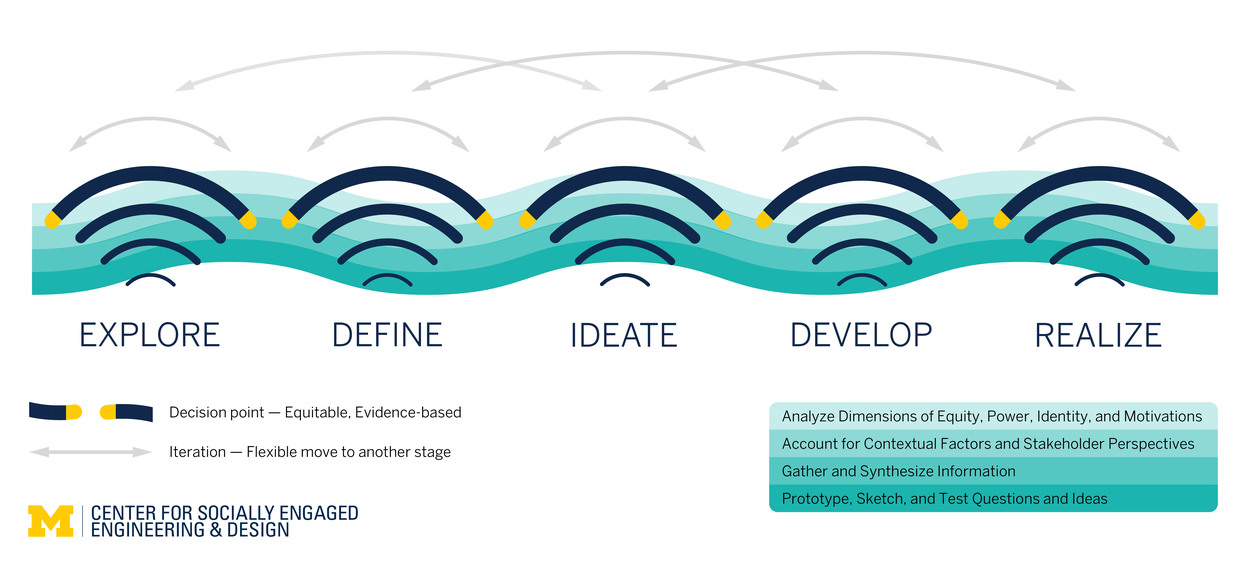
Learners start off with Explore: students are encouraged to think deeply about a problem in the real world, the individuals or systems it's affecting, and how bias or power structures might influence their understanding.
The Define stage helps learners break down the complexity from the explore stage into smaller issues, find patterns, recognize constraints, and articulate a more specific challenge.
Ideate allows learners to get creative. Ideation allows students to think big about many possible solutions while working within the frame they created during the define phase.
Develop helps people critically analyze and test their solution ideas through various technical and social lenses. This is where students get their hands dirty, building, sketching, and coding to bring ideas to life.
Realize allows for broad interpretation. It could mean introducing your solution to a community, launching a new tool for a website, or “realizing” that something was missed and returning to a previous stage for more ideating and development.
Students were enthusiastic about the Socially Engaged Design Model, and before long, the faculty team was asking themselves how they could present it to learners everywhere. Adapting the model into an open online course was a natural next step. Introduction to Socially Engaged Design allowed the team to apply the lessons they taught in traditional classrooms at the University of Michigan to a more global audience. In this online version, the team stressed the importance of case studies and lived experiences as a student learning baseline.
The Importance of Slowing Down
The framework’s basis was not just about giving engineers another assignment, but to create a model for doing. “This model encourages you to slow down and consider all the factors and let that inform you to a better first solution that maybe doesn't fail, you know, or at least, these trade-offs have been considered,” said Skerlos.
At its heart, the Socially Engaged Design framework isn't just a method — it's a mindset. One that challenges engineers to center humanity, equity, and reflection in everything they build. “Failure can have a massive impact on people and the planet. This is why we're encouraging intentional and holistic thinking,” Michaels said.

The team wanted the model to be fluid, encouraging students to reflect throughout the process and slow down to ensure they’re still in line with the true needs of people who experience the problems they seek to develop solutions for. They included undercurrents, touchpoints, and ripple effects to help students focus on introspection within each part of the design process. This allows them to return to previous stages in the model if they’re hitting roadblocks or unsure if they’ve changed course too drastically.
By pushing against familiar narratives in the field, the C-SED team hopes to shift how engineers approach their work. “The initial thought wasn’t just making a cool program at Michigan,” said Skerlos. “Our mission is much more about changing the culture of engineering.”