
Your browser is ancient!
Upgrade to a different browser to experience this site.
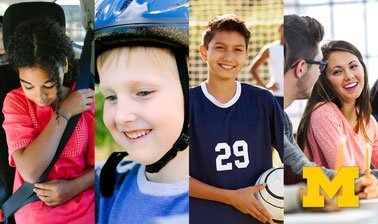
Injury Prevention for Children & Teens

What You'll Learn

  • Key concepts for successful injury prevention in children and teens, including Advocacy at both the local and national levels and health inequities in injury
  • Intentional injury prevention including Bullying, Dating Violence, Sexual Violence, ACES and Child Maltreatment, Firearm Injury, and Suicide Prevention
  • The Opioid Epidemic and Adolescent Substance Use
  • Preventing unintentional injuries, such as Burns and Drowning
8 Modules
32 Hours
4 hrs per module (approx.)

About Injury Prevention for Children & Teens

Injuries, such as motor vehicle crash, youth violence, and suicide, are the leading cause of child and adolescent death. However, almost all of these injuries can be prevented through the widespread application of evidence-based practices and policies.

Public health experts, nurses, physicians, social workers, teachers, child care providers, and parents all play a vital role in pediatric injury prevention. Despite its impact, very little training on injury prevention science currently exists.

This course lays a broad foundation for pediatric injury prevention and will increase your understanding of this major public health issue through powerful, concise, up-to-date lectures, interviews, and demonstrations from a multidisciplinary panel of nationally-recognized injury prevention experts.

This course is designed for multiple fields and levels of training, including healthcare, kinesiology, public policy, social work, pharmacy, dentistry, and psychology.The course is also appropriate for educators, coaches, child care providers, and parents.

Asa learner, you will have the ability to select all modules or individual topics that interest you most. Comprised of 8 modules, this course may be taken from the comfort of your home or office, and you can learn at your own pace.

Obtaining Credit for Continuing Education

Learners may apply for Continuing Medical Education (CME), American Board of Pediatrics’ (ABP) Maintenance of Certification (MOC) Part II, or Certified Health Education Specialist (CHES) credit. See the FAQ for more information on each offering.

Skills You'll Gain

  • Certified Health Education Specialist
  • Health Education
  • Injury Prevention
  • Pediatrics
  • Population Health
  • Public Health

What You'll Earn

Certificate of Completion:
Certificates of completion acknowledge knowledge acquired upon completion of a non-credit course or program.
Experience Type
100% Online
Format
Self-Paced
Subject
  • Health
Platform
edX
Credit Eligibility
  • CEU Eligible
Welcome Message

Injury Prevention for Children & Teens examines the leading causes of injury across childhood and adolescence through a public health lens. Learners explore prevention strategies, health inequities, behavioral theory, and advocacy approaches to reduce injury risk and promote resilience among young populations.

This abbreviated syllabus description was created with the help of AI tools and reviewed by staff. The full syllabus is available to those who enroll in the course.

Course Schedule

Module 1: Welcome to the Course!

  • Welcome to the Course!
  • Course Map

Module 2: Introduction to Child and Adolescent Injuries

  • Injury Definition
  • Injury Definition Assessment (9 Questions)
  • Risk and Promotive Factors
  • Risk and Promotive Factors Assessment (10 Questions)
  • Theory
  • Theory Assessment (3 Questions)
  • Prevention
  • Prevention Assessment (4 Questions)
  • Module 2 Feedback
  • Module 2 Feedback and Continuing Education Credit

Module 3: Intentional Injuries

  • Peer Violence & Bullying
  • Peer Violence & Bullying Assessment (5 Questions)
  • Dating Violence
  • Dating Violence Assessment (5 Questions)
  • Sexual Violence
  • Sexual Violence Assessment (10 Questions)
  • Firearm Safety
  • Firearm Safety Assessment (4 Questions)
  • Suicide
  • Suicide Assessment (10 Questions)
  • Adverse Childhood Experiences (ACEs)
  • Adverse Childhood Experiences Assessment (6 Questions)
  • Child Maltreatment
  • Child Maltreatment Assessment (11 Questions)
  • Module 3 Feedback
  • Module 3 Continuing Education Credit and Feedback

Module 4: Transportation Safety

  • Infant/Child Passenger Safety
  • Infant/Child Passenger Safety Assessment (10 Questions)
  • Teen Driving
  • Teen Driving Assessment (5 Questions)
  • Vulnerable Road Users
  • Vulnerable Road Users Assessment (4 Questions)
  • Module 4 Feedback
  • Module 4 Continuing Education Credit and Feedback

Module 5: Sport Injury Prevention

  • Sports Injury Prevention
  • Sports Injury Prevention Assessment (4 Questions)
  • Module 5 Feedback
  • Module 5 Continuing Education Credit and Feedback

Module 6: Adolescent Substance Use and Injury

  • Adolescent Substance Use
  • Adolescent Substance Use and Injury Assessment (8 Questions)
  • Rx Pediatric/Adolescent Drug Misuse
  • Rx Pediatric/Adolescent Drug Misuse Assessment (5 Questions)
  • Module 6 Feedback
  • Module 6 Continuing Education Credit and Feedback

Module 7: Early Childhood Unintentional Injury

  • Drowning Prevention
  • Drowning Prevention Assessment (4 Questions)
  • Burn Prevention
  • Burn Preventional Assessment (10 Questions)
  • Module 7 Feedback
  • Module 7 Continuing Education Credit and Feedback

Module 8: Injury Prevention Advocacy

  • Injury Prevention Advocacy
  • Injury Prevention Advocacy Assessment (5 Questions)
  • Module 8 Feedback
  • Module 8 Continuing Education Credit and Feedback
  • Course Wrap-Up
Grading Policy

Learners must earn at least 70% overall across all quizzes to pass. Quiz completion is required in sequence.

Course content developed by U-M faculty and managed by the university. Faculty titles and affiliations are updated periodically.

Beginner Level

No prior experience required

Enrollment Options

Individuals

This experience is available to individual learners on the following platforms:

U-M Community

Students, faculty, staff, and alumni of the University of Michigan get free access.

Organizations

Special pricing and tailored programming bundles available for organizational partners.

What are Coursera and edX?

Michigan Online learning experiences may be hosted on one or more learning platforms. Platform features may vary, including payment models, social communities, and learner support.

Coursera

  • Hosts online courses, series, and Teach-Outs from Michigan Online
  • Enroll and preview courses anytime
  • May earn a non-credit certificate from Coursera

edX

  • Hosts online courses and series from Michigan Online
  • Many offer a free (limited) audit option
  • May earn a non-credit certificate from edX

For more information visit the What are Coursera and edX? FAQ section

Michigan Online
For You

Sign up for a Michigan Online account to customize your experience!