Is an Online Degree Right for You?

The University of Michigan's online degree programs offer rigor and flexibility for students seeking new opportunities
You’ve identified your next steps, whether it’s to apply for a leadership role, open your own consulting firm, or take a step toward becoming a nurse practitioner—and a University of Michigan degree can help you achieve that goal.
Now to figure out how to pursue that dream without disrupting your life. You need flexibility and affordability, but want the same quality education available on campus. You want to make connections, gain experience, and earn credentials while balancing your job or family.
For a rising number of learners, the answer is an online degree from the University of Michigan.
What is an Online Degree
U-M has offered online certifications and degrees for decades, and over the years has fine-tuned its offerings to be among the top-ranked online degree programs in the nation.
Online degree programs at U-M are designed and taught by the same instructors as the on-campus program. While each program is unique, they typically offer a blend of online activities, study materials, and pre-recorded content that you can engage with on your own time, and many offer live virtual sessions with instructors and peers. Some programs include in-person opportunities such as residencies and on-campus workshops.
The result is an interactive, holistic program that both challenges its students and supports their aspirations.
“The online program really aims to give the same academic rigor as our traditional on-campus program,” said Antuan Featherstone, online MSW program manager and adjunct lecturer at the U-M School of Social Work. “It allows them to immerse themselves in an academic learning environment where they can still live life, but also have access to the number one program in the country.”
Online degrees equally valued
Despite the different modality, online degree programs are equally rigorous and equally valued, with employers increasingly hiring online graduates.
More than 83% of human resources professionals in the U.S. view an online degree as being equally credible as a traditional credential, and nearly 90% have hired graduates who’ve earned an online degree.
That shift in perception is reflected by the students enrolled in online degree programs. A 2024 survey of online learners revealed that 90% believe the quality of an online degree is comparable to or better than an on-campus credential.
In addition to the quality education, online learners are attracted to career advancement opportunities that don’t require pausing their careers or uprooting their lives.
“You don’t have to pick up your life and move across the country to access the University of Michigan,” said Barb Hiltz, clinical associate professor and academic program director at the School of Social Work.
Is an Online Degree Right for You?
Flexibility and affordability
While online learners hail from a wide variety of backgrounds and industries, they do share common motivators—flexibility and affordability. Their pursuit of career advancement or upskilling often runs parallel to a full-time job or balancing family duties.
Ashley O’Brien is currently a senior manager in talent management at Kraft Heinz in Chicago. In 2016, she began exploring part-time MBA programs, but at that time only found weekend programs, which would siphon many hours away from her young family. She rebooted her search in 2023 and discovered the Online MBA from U-M’s Ross School of Business. O’Brien was in.
“I could see myself being able to progress my career, being able to have my goals of getting an MBA from Ross, and not sacrifice my experience of how I wanted to raise my family,” said O’Brien, who is set to graduate this May.
Leo Calaj, a Global Automotive and Manufacturing Engineering online master’s degree candidate with U-M’s College of Engineering, appreciated the savings of not having to relocate to Ann Arbor.
“You’re only paying for credit hours, but you’re getting a very high-quality education, the same education that somebody who’s there in person would get,” said Calaj, who began his degree through a General Motors tuition assistance program. “It’s exceeded my expectations.”
Access
The flexibility of online degree programs, many of which offer part-time and full-time options, has attracted learners who otherwise may not have applied.
“We provide education to traditionally underserved communities of learners who were not able to follow a traditional collegiate path, but now have access to those degree programs and to our faculty,” said Sarah DeWard, senior learning experience designer for Ross.

Instructors say online learners add great value to their cohorts. These students come from a wide spectrum of backgrounds, from eager learners who’ve just earned their bachelor’s degree to mid-career professionals with a decade of experience. They include members of the military, parents and caregivers, residents from Michigan and across the country—all contributing different perspectives to their virtual classrooms.
“The diversity of many, many identities and positionalities, that lived experience really adds to the classroom environment and richness of the conversations we engage in,” said David Cordova, a professor in the School of Social Work.
What Do You Need to Succeed as an Online Student?
Just as they come from varied backgrounds, students also possess a variety of skills important to successfully tackle an online degree program.
Faculty and students alike point to time management, self-discipline, and consistent drive at the top of a long list of factors key to online learning success. William Lopez, clinical associate professor of health behavior and health equity at the School of Public Health, sees his learners managing rich external lives alongside the demands of the program.
“The most successful online students tend to be pretty good at compartmentalizing their time,” said Lopez. “The ability to work in small chunks of time, and have a constant curiosity toward public health, are all characteristics of successful students.”
Carving out the time and dedicated space for coursework and studying helps learners shift their focus from jobs and family to the degree program. Jamal Shaheen, an Online MBA student at Ross, avoids the bustle of busy coffee shops, preferring instead the silence of his home office or a library.
“I enjoy the solitude and the peace and quiet, and that really helps me get through some of the more difficult classes,” he said.
O’Brien has a dedicated desk in her children’s playroom, but sometimes has had to log into her coursework from the airport or join a group project call from a taxi. It’s while managing these challenges that O’Brien leans on her determination to achieve an MBA degree from Ross.
“As an online learner, it’s helpful to have the discipline, but also understand and remind yourself why you are doing this,” she said. “Why did you sign up for this? Why is this important to you, so that you actually do get the most out of the learning experience.”
During his time instructing online certificate and master’s courses, Vineet Kamat, director of graduate degree programs for the College of Engineering, a professor of civil and environmental engineering, and the John L. Tishman Family Professor of Construction Management and Sustainability, has observed the importance of motivation and striving toward a goal.
“The successful students are very well motivated, are clear about their intent and what it is they want to study, and why they want to study, and where this will take them,” said Kamat. “Clarity about not only educational and professional advancement plans, but also clarity about their logistical plans—these two attributes primarily lead to success.”
What Kind of Support is Available to Online Degree Students?
Online degree students also point to the intangible skills acquired through their programs—in addition to a University of Michigan degree.
They highlight improved strategic thinking, expertise in digital tools, leadership capabilities, and learning to network with peers and industry professionals.
“There’s many, many things, but collaboration from a project standpoint, presentation skills, time management—all of those intangibles,” said Calaj. “New skills that I can apply to my everyday job or a future job down the line.”
While online learners place themselves in the driver’s seat of their education, the U-M degree programs offer a deep network of support, guidance, and engagement opportunities to their students. Resources available often include access to academic advising, student affairs personnel, career coaching, professional networking, and U-M facilities and libraries. Each program provides appropriate benefits meant to encourage the success of their online students.
“There’s always an opportunity to join different clubs related to certain industries as well as different activities that are relevant to you,” said Shaheen. “By no means are we compromising or putting pause on anything while pursuing our education.”
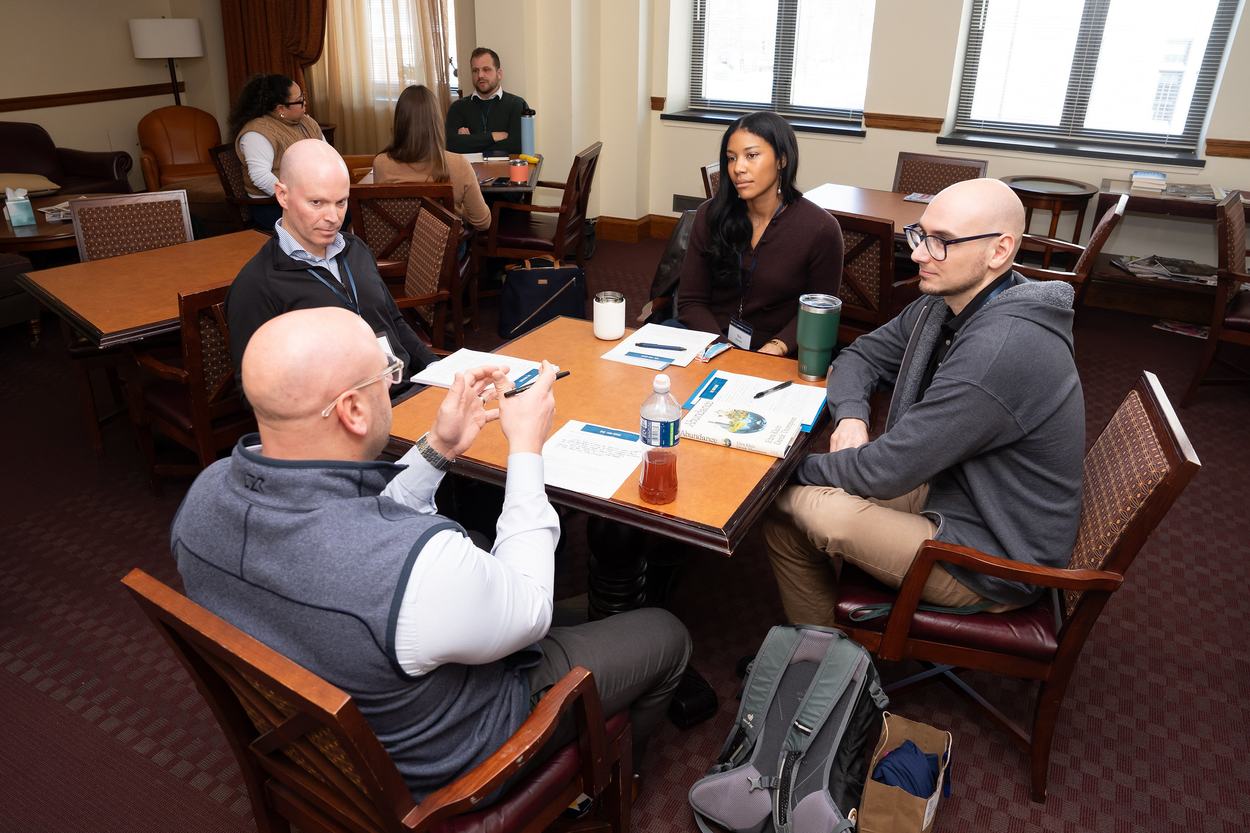
Connecting students with these resources, as well as each other, is a priority for program directors and instructors. With learners joining remotely, faculty intentionally shape the experience to facilitate connection across distance, whether that’s with a ‘cameras on’ policy, synchronous office hours and breakout groups, or by bringing learners together for on-campus residencies or optional workshops.
With flexibility, affordability, and quality education as the motivators, and a foundation of rigor, opportunity, and support, learners are finding their pathways to success in the online degree programs at the University of Michigan.
“If you’re looking for an environment where you can be challenged and really work with this knowledge and information, this is a good place to do so,” said Featherstone. “You’ll be challenged, and you really have an opportunity to stretch yourself.”