
Your browser is ancient!
Upgrade to a different browser to experience this site.
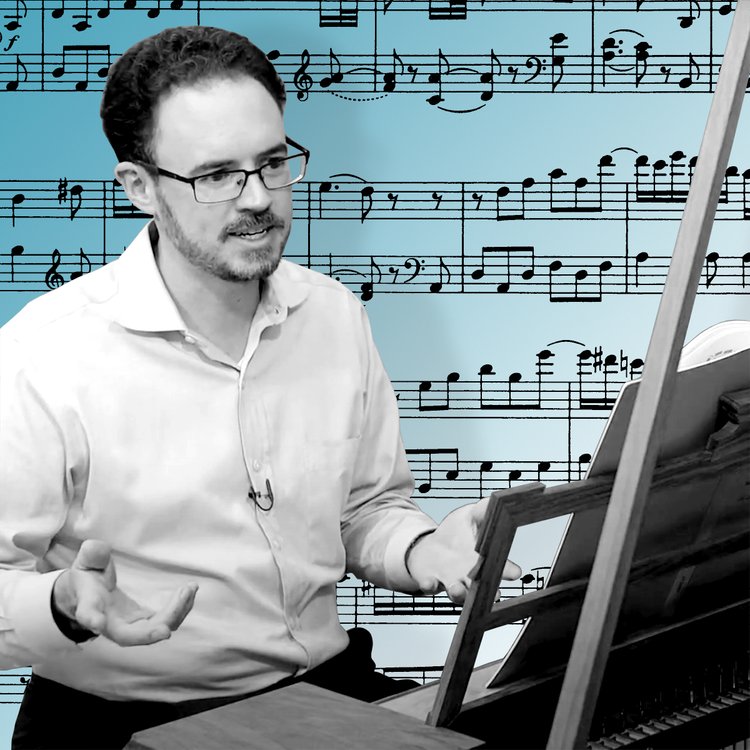
The Piano Sonata: Origins to Mozart

What You'll Learn

  • Understand how sonata form works and where it came from.
  • Analyze the early history of the piano sonata.
  • Differentiate between Baroque, Galant, and Classical styles.
4 Modules
8 Hours
2 hrs per module (approx.)
Rating

About The Piano Sonata: Origins to Mozart

In this course, you’ll be introduced to sonata form; how it works, where it came from, and how sonatas are put together as multi-movement compositions. We will analyze the early history of the piano sonata and discover the important early masters of this style (Scarlatti, CPE Bach, Haydn, and Mozart). You’ll then investigate the relationship between the keyboard instruments of the time and the musical style, and be able to differentiate between Baroque, Galant, and Classical styles.

This course was filmed at the University of Michigan School of Music, Theatre & Dance, among other locations, to showcase the depth of the sonata repertoire and the instruments that contributed to its history.

Skills You'll Gain

  • Music History
  • Music Theory

What You'll Earn

Certificate of Completion:
Certificates of completion acknowledge knowledge acquired upon completion of a non-credit course or program.
Experience Type
100% Online
Format
Self-Paced
Subject
  • Arts & Culture
Platform
Coursera
Welcome Message

Welcome to The Piano Sonata: Origins to Mozart, part of the Exploring Piano Literature series. Learners explore the origins of sonata form, early keyboard instruments, and stylistic developments leading to Mozart’s mature works.
This abbreviated syllabus description was created with the help of AI tools and reviewed by staff. The full syllabus is available to those who enroll in the course.

Course Schedule

Module 1: Setting the Stage

  • Video: Course Introduction: Setting the Stage
  • Reading: Course Syllabus
  • Discussion Prompt: Introduce Yourself
  • Reading: Help Us Learn More About You
  • Video: Sonata Characteristics & Composers
  • Video: Sonata Form: Principles, Origins, Processes, and Theorists
  • Video: Sonata Form Overview
  • Video: Movement Architecture
  • Graded: Sonata Form & Movement Architecture

Module 2: Dawn of the Sonata

  • Reading: Introduction: Origins and Centers of Influence
  • Reading: Keyboard Instruments: Harpsichord & Clavichord
  • Video: Keyboard Instruments: Harpsichord
  • Video: Keyboard Instruments: Clavichord
  • Reading: Keyboard Instruments: Early Pianos – Cristofori design
  • Video: Keyboard Instruments: Early Pianos – Square
  • Reading: Early Italian Sonata Composers and Galant Style
  • Reading: Domenico Scarlatti (1685-1757)
  • Video: Instrumentation for Domenico Scarlatti
  • Video: A Look at Scarlatti Sonatas
  • Reading: Domenico Scarlatti Sonata K. 253 in E-flat
  • Reading: Other Iberian Composers
  • Reading: Carl Philipp Emanuel (CPE) Bach (1714-1788)
  • Video: Two Early B-flat Sonatas by CPE Bach
  • Video: Johann Christian (JC) Bach (1735-1782)
  • Discussion Prompt: Musical Features & Keyboards
  • Graded: Keyboards & Early Italian Composers
  • Graded: Scarlatti, Iberian Composers, and Sons of Bach Quiz

Module 3: Viennese Classics: Haydn and Mozart

  • Reading: Social Context and Purpose
  • Video: Early Viennese Piano
  • Video: English Grand Piano
  • Reading: Joseph Haydn (1732-1809)
  • Video: Haydn's Sonata in F Major, Hob. XVI/23
  • Video: Haydn's Sonata in C Major, Hob. XVI/48
  • Video: Haydn's Sonata in E-flat major, Hob. XVI/52
  • Graded Assignment: Social Context & Purpose and Haydn’s Sonatas
  • Reading: Wolfgang Amadeus Mozart (1756-1791)
  • Video: Mozart's Sonata in F major, K. 332
  • Video: Mozart's Sonata in D major, K. 311
  • Video: Mozart's Sonata in C minor, K. 457
  • Reading: Haydn and Mozart: Chronology
  • Reading: Two Great Sonatas from 1789: Introduction
  • Video: Two Great Sonatas From 1789: First Movements
  • Video: Two Great Sonatas From 1789: Second Movements
  • Video: Two Great Sonatas From 1789: Finales
  • Discussion Prompt: Social Conditions & Creative Potential
  • Discussion Prompt: Discussion about Sonata

Module 4: Conclusion and Optional Honors Project

  • Reading: Post-Course Survey
  • Reading: Honors Lesson: Score Analysis
  • Reading: Formal Analysis: Mozart's Sonata K. 284 in D Major, Movement I
  • Reading: Formal Analysis: Answer Key
  • Discussion Prompt: Formal Analysis Discussion: Mozart's Sonata K. 284 in D Major, Movement I
  • Graded: Honors Lesson Commitment
Grading Policy

Learners complete three graded quizzes, with each being worth 33.3% of their final grade. There are also optional Honors Lessons that are ungraded.

Course content developed by U-M faculty and managed by the university. Faculty titles and affiliations are updated periodically.

Intermediate Level

Some related experience required

Course Video

Enrollment Options

Individuals

This experience is available to individual learners on the following platforms:

U-M Community

Students, faculty, staff, and alumni of the University of Michigan get free access.

Organizations

Special pricing and tailored programming bundles available for organizational partners.

What are Coursera and edX?

Michigan Online learning experiences may be hosted on one or more learning platforms. Platform features may vary, including payment models, social communities, and learner support.

Coursera

  • Hosts online courses, series, and Teach-Outs from Michigan Online
  • Enroll and preview courses anytime
  • May earn a non-credit certificate from Coursera

edX

  • Hosts online courses and series from Michigan Online
  • Many offer a free (limited) audit option
  • May earn a non-credit certificate from edX

For more information visit the What are Coursera and edX? FAQ section

Reviews and Ratings

4.9

23 Ratings from Coursera

What Learners Are Saying

Michigan Online
For You

Sign up for a Michigan Online account to customize your experience!