
Your browser is ancient!
Upgrade to a different browser to experience this site.
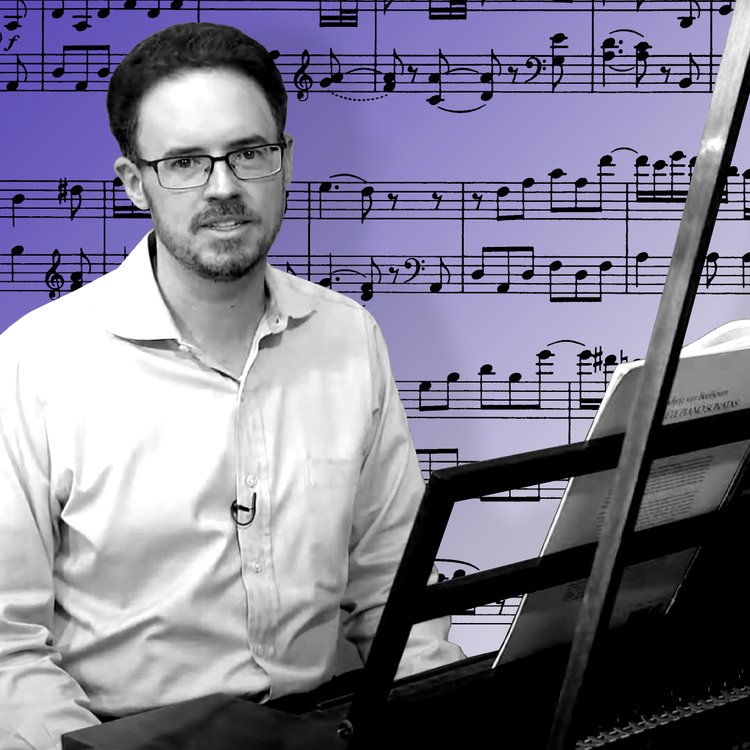
The Piano Sonata: Beethoven and the Romantics

What You'll Learn

  • Learn how the piano sonata was taken to new heights by Beethoven.
  • Explore the "War of the Romantics."
  • Understand the differences between Viennese and English/French traditions of piano music.
4 Modules
12 Hours
3 hrs per module (approx.)
Rating

About The Piano Sonata: Beethoven and the Romantics

In this course, learners will review sonata form and learn how the piano sonata was taken to new heights by Ludwig van Beethoven. We’ll discover together how the generation that followed interpreted Beethoven’s achievements and put them into practice in their own unique ways. From there, we will explore the “War of the Romantics”: the variety of formal structures for Romantic sonatas (both traditional and progressive) and the major repertoire of this era. You’ll hear some of the important pianos of the time, and understand the differences between Viennese and English/French traditions of piano music.

This course was filmed at the University of Michigan School of Music, Theatre & Dance, among other locations, to showcase the depth of the sonata repertoire and the instruments that contributed to its history.

Skills You'll Gain

  • Music History
  • Music Theory

What You'll Earn

Certificate of Completion:
Certificates of completion acknowledge knowledge acquired upon completion of a non-credit course or program.
Experience Type
100% Online
Format
Self-Paced
Subject
  • Arts & Culture
Platform
Coursera
Welcome Message

Welcome to The Piano Sonata: Beethoven and the Romantics, part of the Exploring Piano Literature series. This course examines how Beethoven transformed sonata form and how Romantic composers expanded its expressive and structural possibilities.


This abbreviated syllabus description was created with the help of AI tools and reviewed by staff. The full syllabus is available to those who enroll in the course.

Course Schedule

Module 1: Setting the Stage

  • Video: Course Introduction: Setting the Stage
  • Reading: Course Syllabus
  • Discussion Prompt: Introduce Yourself
  • Reading: Help Us Learn More About You
  • Reading: Putting Sonatas Together
  • Video: Sonata Characteristics & Composers
  • Video: Sonata Form: Principles, Origins, Processes, & Theorists
  • Video: Sonata Form Overview
  • Video: Movement Architecture
  • Graded: Sonata Form & Movement Architecture

Module 2: Ludwig van Beethoven

  • Video: Beethoven's 32 Sonatas: Social Context and Musical Influences
  • Reading: Beethoven: Theoretical Matters
  • Reading: Early Period (1795-1800)
  • Video: Later Viennese Piano
  • Video: Sonata op. 2 no. 1 in F minor
  • Video: Early Fermatas in Beethoven
  • Video: Sonata op. 13 in C minor "Pathetique"
  • Reading: Transitional Period (1800-1802)
  • Video: Sonata op. 31 no. 2 in D minor "Tempest"
  • Reading: Middle Period (1803-1810)
  • Video: 5.5 Octave Piano
  • Video: Sonata op. 53 in C major "Waldstein"
  • Reading: Late Period (1814 and Beyond)
  • Video: Graf Piano
  • Discussion Prompt: Beethoven & Stereotypes
  • Video: Sonata op. 110 in A-flat major
  • Discussion Prompt: Reasons for Repeating Musical Ideas
  • Graded: Beethoven: Theoretical and Social Context and Early Sonatas
  • Graded: Transitional and Middle Periods
  • Graded: Beethoven Sonatas: Late Period and Wrap-Up

Module 3: Romantics

  • Video: Clementi, Dussek, Weber, and Hummel
  • Reading: Franz Schubert (1797-1828)
  • Video: Schubert's "Little" A major Sonata, D. 664
  • Video: Schubert's "Great" A major Sonata D. 959
  • Discussion Prompt: Schubert's Approach to the Sonata
  • Reading: Romantic Sonatas: Stylistic Context
  • Video: Schumann Sonatas
  • Video: Schumann's Sonata no. 2 in G minor
  • Reading: Johannes Brahms (1833-1897)
  • Video: Brahms's Sonata no. 3 in F minor
  • Reading: Frédéric Chopin (1810-1849)
  • Video: Érard Piano
  • Video: Chopin's Sonata no. 3 in B minor
  • Reading: Franz Liszt (1811-1886)
  • Video: Liszt's Sonata in B minor
  • Discussion Prompt: Following Liszt's Form
  • Graded: The Early 19th Century: Virtuosi & Schubert
  • Graded: Romantic Sonatas: Stylistic Context, Schumann, and Brahms
  • Graded: Chopin & Liszt

Module 4: Course Conclusion and Honors Track Formal Analysis

  • Reading: Post-Course Survey
  • Reading: Honors Lesson: Score Analysis
  • Reading: Formal Analysis: Beethoven's Sonata Opus 22 in B-Flat
  • Reading: Answer Key: Beethoven's Sonata Opus 22 in B-Flat
  • Discussion Prompt: Formal Analysis Discussion: Beethoven's Sonata Opus 22 in B-Flat
  • Graded: Honors Lesson Commitment
Grading Policy

Learners complete seven graded quizzes throughout the course, and each quiz is equally weighted. Optional Honors activities are ungraded.

Course content developed by U-M faculty and managed by the university. Faculty titles and affiliations are updated periodically.

Intermediate Level

Some related experience required

Course Video

Enrollment Options

Individuals

This experience is available to individual learners on the following platforms:

U-M Community

Students, faculty, staff, and alumni of the University of Michigan get free access.

Organizations

Special pricing and tailored programming bundles available for organizational partners.

What are Coursera and edX?

Michigan Online learning experiences may be hosted on one or more learning platforms. Platform features may vary, including payment models, social communities, and learner support.

Coursera

  • Hosts online courses, series, and Teach-Outs from Michigan Online
  • Enroll and preview courses anytime
  • May earn a non-credit certificate from Coursera

edX

  • Hosts online courses and series from Michigan Online
  • Many offer a free (limited) audit option
  • May earn a non-credit certificate from edX

For more information visit the What are Coursera and edX? FAQ section

Reviews and Ratings

4.8

5 Ratings from Coursera

What Learners Are Saying

Michigan Online
For You

Sign up for a Michigan Online account to customize your experience!