
Lecturer IV Emerita in Statistics, College of Literature, Science, and the Arts
Your browser is ancient!
Upgrade to a different browser to experience this site.
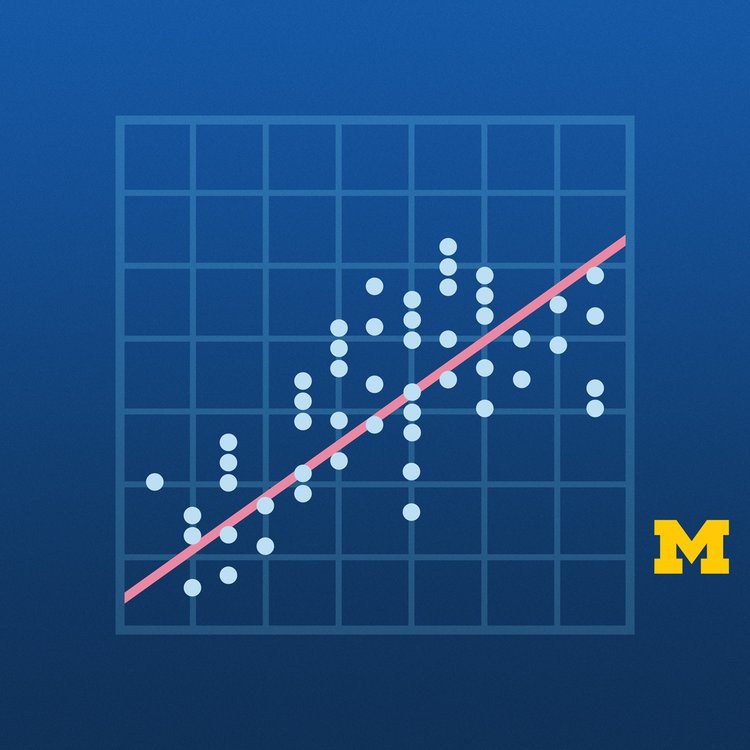
In this course, we will expand our exploration of statistical inference techniques by focusing on the science and art of fitting statistical models to data. We will build on the concepts presented in the Statistical Inference course (Course 2) to emphasize the importance of connecting research questions to our data analysis methods. We will also focus on various modeling objectives, including making inference about relationships between variables and generating predictions for future observations.
This course will introduce and explore various statistical modeling techniques, including linear regression, logistic regression, generalized linear models, hierarchical and mixed effects (or multilevel) models, and Bayesian inference techniques. All techniques will be illustrated using a variety of real data sets, and the course will emphasize different modeling approaches for different types of data sets, depending on the study design underlying the data (referring back to Course 1, Understanding and Visualizing Data with Python).
During these lab-based sessions, learners will work through tutorials focusing on specific case studies to help solidify the week’s statistical concepts, which will include further deep dives into Python libraries including Statsmodels, Pandas, and Seaborn. This course utilizes the Jupyter Notebook environment within Coursera.
Fitting Statistical Models to Data with Python, a course that is part of the Statistics With Python series, builds on statistical inference foundations to help learners connect research questions with appropriate modeling techniques. You will explore linear and logistic regression, multilevel models, and Bayesian approaches using real-world datasets. Through hands-on labs and Python-based assessments, learners strengthen both conceptual understanding and applied data analysis skills.
This abbreviated syllabus description was created with the help of AI tools and reviewed by staff. The full syllabus is available to those who enroll in the course.
Module 1: Overview & Considerations for Statistical Modeling
Module 2: Fitting Models to Independent Data
Module 3: Fitting Models to Dependent Data
Module 4: Special Topics
Grades are based on conceptual quizzes and Python assessments. Weights range from 10% to 20% per assessment, with Python assessments comprising the largest portion of the final grade.
Lecturer IV Emerita in Statistics, College of Literature, Science, and the Arts

Associate Chair, Department of Statistics and Professor of Statistics, College of Literature, Science, and the Arts

Collegiate Research Professor, Faculty Associate, Population Studies Center, Research Professor, Survey Research Center, Institute for Social Research, Adjunct Lecturer in Quantitative Methods and Social Sciences Program, College of Literature, Science, and the Arts and Research Professor, Biostatis
Course content developed by U-M faculty and managed by the university. Faculty titles and affiliations are updated periodically.
Intermediate Level
Completion of the first two courses in this specialization; high school-level algebra